
Advertisement
In an era defined by corporate uncertainty, technological disruption, and an evolving entrepreneurial landscape, the ability to reinvent oneself has become an essential measure of leadership. For Jonathan Kyle, founder and CEO of Ten Sparrows, an unexpected career transition became the catalyst for a bold new chapter rooted in innovation, resilience, and purpose. Drawing upon years of experience in the technology industry, Kyle transformed professional uncertainty into an opportunity to establish a company committed to making artificial intelligence more responsible, accessible, and impactful.
His journey is a compelling testament to the power of preparation, strategic vision, and the courage to embrace change. In this exclusive conversation with *The Network Journal*, Kyle reflects on the lessons of corporate leadership, the realities of entrepreneurship, and his determination to build a business that creates both economic opportunity and meaningful social impact.
Jonathan, your journey into entrepreneurship began following a corporate restructuring that changed the trajectory of your professional career. Take us back to that defining moment. How did you navigate the uncertainty, and what inspired you to transform an unexpected professional setback into an opportunity to build something of your own?
I worked at Intel from 2019 to 2025. During those years, the company faced difficult sales and revenue conditions, followed by round after round of layoffs. It began to feel like a death by a thousand cuts. I understood that my team would eventually be affected. Atlanta was considered a relatively small site, and even the strategic importance of our work could only delay the inevitable. Rather than allow that uncertainty to consume us, I encouraged my team to prepare. I would tell them, “Stay ready so you don’t have to get ready.”
As a director and the Atlanta site lead, I also had a responsibility to help people navigate what was coming. Closing an office with approximately 150 employees and a lab takes coordination and time. That gave me an opportunity to provide as many colleagues as possible with advance notice that the site was closing and layoffs were ahead. I was grateful to be in a position to help people prepare. When the moment finally arrived, I felt relief, and even a sense of empowerment. The uncertainty was over. Intel provided meaningful severance and benefits to ease the transition, and I appreciated that support.
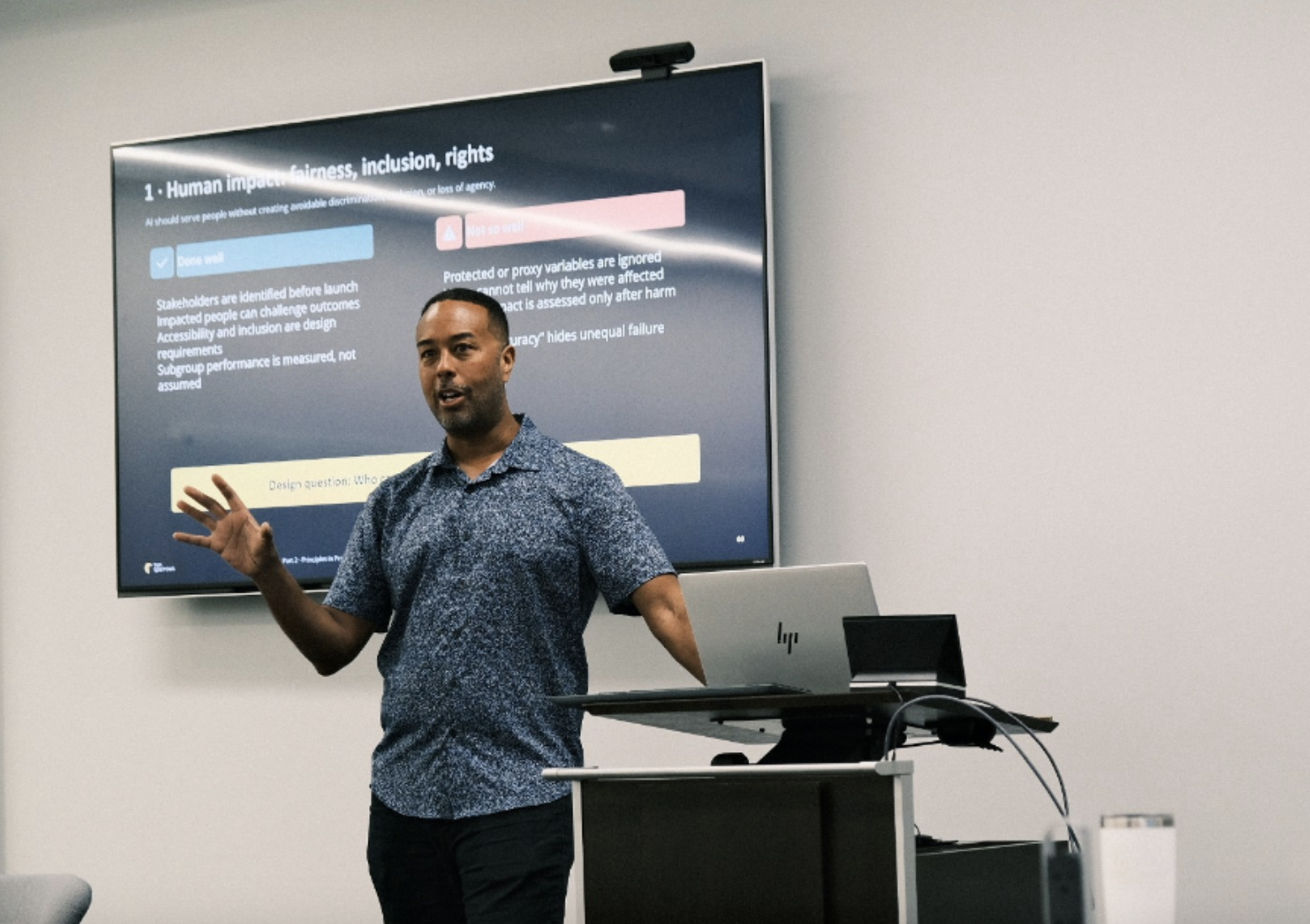
The job market in 2025 was particularly challenging. Major technology companies were laying off employees, few were hiring, and the market was full of accomplished people looking for their next opportunity. But the severance also gave me a financial runway to try something I had long considered: building a company as a founder. I took stock of what I had learned, the people around me, and the problems I wanted to solve. Ten Sparrows was not simply a response to a layoff. It was an opportunity to bring my curiosity, experience, and desire to innovate into a company of my own—one that makes advanced technology useful to people who are too often left out of its benefits.
Corporate America often provides a sense of stability, professional identity, and financial security. What did stepping away from that environment teach you about yourself, particularly your resilience, resourcefulness, and capacity to embrace the unknown?
Corporate America can offer a strong sense of stability, identity, and security. For a long time, so could being a software engineer or working in technology. Then large-scale layoffs and the rapid rise of AI challenged those assumptions. I have always known that I am naturally risk-averse, but I am also adaptable. I had worked at several technology startups during my career, just never as the founder. Taking that step meant moving outside the familiar structure of a large corporation and learning to trust the judgment I had developed along the way.
What surprised me was how much I already had to draw on. I had built a broad network of accomplished people who were generous with their insight, encouragement, and introductions. I also realized how many leadership and business lessons I had absorbed over the years. My upbringing taught me to be resourceful when resources were scarce, but my career taught me how to organize people, solve problems, and make consequential decisions. Together, those experiences gave me the confidence to take an informed risk rather than a reckless one.
I do not believe in the myth of pulling yourself up by your bootstraps. I had help. Everyone has help, whether they recognize it or not. The people who advise us, challenge us, open doors, and believe in us are part of any success story. Stepping away from corporate life taught me that I could make bold moves without abandoning discipline, and that my sense of identity and security did not have to depend on an employer. I could begin creating those things for myself, supported by the people and relationships I had invested in throughout my life.
Many aspiring entrepreneurs have compelling ideas but struggle to find the courage to pursue them. What gave you the conviction to establish Ten Sparrows, and how did you overcome the inevitable fears and doubts associated with launching a business?
Establishing Ten Sparrows was intentional. I have been fascinated by building technology since childhood, when my mother brought home a VIC-20 and later a Commodore 64 and I discovered I could program my own games. Over time, that curiosity became a larger ambition: to help build a company that stays at the leading edge of innovation, brings together people with genuinely different backgrounds and perspectives, and produces exceptional outcomes because of that diversity.
I wanted Ten Sparrows to be known for the quality of its technology, the character of its people, and the value it creates. We are proud to be a minority-owned business, and representation matters deeply to me. But I want people to see an outstanding technology company first—one that also happens to be minority-owned. Those qualities reinforce each other. A diverse workforce can recognize needs, question assumptions, and see possibilities that a more homogeneous team might miss. Ultimately, though, we have to earn our reputation through what we deliver.
Of course, starting a business brings fear and doubt. I take those feelings seriously; being risk-averse means I want to understand the downside before I act. But conviction comes from preparation, a clear purpose, and people who will tell you the truth. Family, friends, mentors, and collaborators have all helped me move forward. Even the name Ten Sparrows came from observing nature: my mother noticed sparrows in her garden and imagined one more. I have come to appreciate that our name grew from observation and inspiration rather than a contrived branding exercise. That small moment captures something I value: paying attention to what is right in front of us and imagining what else might be possible.
As the founder and CEO of Ten Sparrows, what is your vision for the company, and how are you positioning the brand to distinguish itself in an increasingly competitive technology marketplace?
BMW built a memorable identity around the phrase “The Ultimate Driving Machine.” I admire how clearly that expresses an ambition. For Ten Sparrows, our ambition is just as direct: “The Responsible AI Company.” We want to help define what responsible AI looks like in everyday use—not just in research papers or large enterprises, but in the lives of individuals, small businesses, and communities.
We build AI agents and agentic workforce experiences through Tribe, along with supporting technology and infrastructure that help people and organizations put AI to work. There is a big difference between giving someone access to an impressive AI tool and giving them something that actually makes life easier. Our goal is to take on the complexity so the customer does not have to, and to make sophisticated capabilities practical for people without a large technical staff.
Responsibility is not simply a marketing claim. It has to be reflected in how an AI system is designed, deployed, and governed. People should be able to understand where an agent’s knowledge comes from, who owns that knowledge and its decisions, and how to intervene, correct, or reverse an action when necessary. We often describe these commitments as provenance, ownership, and reversibility. Those questions become especially important when an agent learns from an employee or makes decisions on behalf of a business.
We do not have to be the loudest company or make the biggest promises. I would rather Ten Sparrows be recognized for thoughtful engineering, trustworthiness, and results. “The Responsible AI Company” is not a claim that we have solved every problem. It is a standard we have chosen for ourselves and an invitation for customers and partners to hold us accountable to it.
Building a successful enterprise requires more than ambition; it demands financial discipline, strategic thinking, and an unwavering commitment to execution. What have been some of your most significant challenges as a new entrepreneur, and how have those experiences influenced your approach to leadership and business development?
Funding is one of the clearest challenges. When you are building ambitious technology with limited capital, you cannot afford to confuse activity with progress. I repeat a simple rule: every dollar has a job. We have to make deliberate choices about what to build, what to test, and what can wait.
Focus is another challenge, especially for a technical founder. Once you know you can build a wide range of things, opportunities appear everywhere. But a compelling demonstration is not the same as a sustainable business. You have to listen closely to customers, discover what problem is worth solving, and prove that the solution creates value. That has sharpened my approach to business development: start with the customer’s work, not with the technology we want to show them.
It has also reinforced how I think about leadership. I look for people who combine technical ability, communication, and empathy. I value partnerships where one plus one equals three, because the right collaborators create an outcome none of us could achieve alone. And I try to remain open to candid feedback. Sometimes the most useful contribution someone can make is to tell you what is not working.
There is often an important distinction between experiencing a professional setback and allowing that setback to define your future. How has this transition reshaped your understanding of success, personal fulfillment, and the importance of taking ownership of your professional destiny?
I am grateful for my corporate career, and I do not need to diminish it to appreciate the chapter I am in now. My transition was not a sudden discovery of entrepreneurship after being blindsided. I saw a difficult change taking shape, prepared for it as best I could, and recognized an opportunity when it arrived. That experience reshaped my understanding of success. Titles, organizations, and projects can matter enormously, but none of them is permanent. What stays with you is what you learned, the people you helped, and what you choose to build next.
I have become more intentional about where I put my time and energy. Success includes building a healthy, sustainable company, certainly. It also includes the freedom to pursue meaningful ideas, to be present with the people I love, and to create opportunities for people who might otherwise be overlooked.
Taking ownership of your future does not mean pretending you can control every outcome. I have learned the opposite. You control the choices you make, the principles you refuse to compromise, and whether you are willing to begin again. I have not become less ambitious. I have become more deliberate about what that ambition is for.
As an entrepreneur building a technology company, how do you envision Ten Sparrows creating meaningful opportunities for individuals, small businesses, and communities that have traditionally faced barriers to accessing innovative technological resources?
I think about the distance between having potential and having the circumstances to realize it. I knew that distance growing up. Curiosity, talent, and determination are not always enough without access to tools, instruction, and support.
I often say that for about $20 a month, a subscription to Claude or ChatGPT gives you superpowers, but it does not make you a superhero. Access to AI is becoming ubiquitous; AI literacy is not. Without judgment and understanding, powerful tools can be dangerous.
AI is a force multiplier. Used thoughtfully, it can help a small business owner serve customers, improve operations, and compete without a large staff. Used cavalierly, it can multiply mistakes just as quickly: you can harm yourself or others, or land in serious trouble, without even recognizing what went wrong. Responsible AI therefore requires literacy, accountability, human judgment, and safeguards, not just access. Ten Sparrows wants to help build that understanding alongside educators, entrepreneurs, and communities, especially here in Atlanta.
What excites me is not AI doing everything for people. It is that more people can build, create, compete, and imagine futures once beyond reach. It is an opportunity to upgrade humanity—not by replacing human initiative, but by expanding what people can do.
Your story speaks to countless professionals who may be confronting corporate restructuring, career displacement, or the realization that their next chapter requires an entirely different path. What advice would you offer someone standing at that crossroads, and what do you hope your entrepreneurial journey demonstrates about the power of determination, faith in oneself, and the courage to begin again?
First, acknowledge the loss. A career transition can affect your security, routines, identity, and the people who depend on you. You do not need to pretend it is easy in order to be strong.
Then look at what remains yours: experience, relationships, curiosity, judgment, and the ability to learn. Prepare before the transition arrives if you can. Talk to people you trust, understand your financial runway, and test an idea before committing everything to it. You do not have to do it alone. Courage and discipline belong together.
Fear does not disqualify you. As I have said before, the parachute will not open if you do not jump. That is not an argument for a reckless leap; it is a reminder that a meaningful next chapter eventually requires action.
I often say, “Earth has to move to make a mountain.” I hope my journey shows that disruption need not be the end of the story. With determination, humility, community, and faith in what you can contribute, it can be a new beginning.
Advertisement